The timeless tale of the Three Little Pigs isn't just a beloved bedtime story; it's a vibrant launching pad for a world of learning and imagination. From the huff and puff of the big bad wolf to the sturdy triumph of the brick house, the narrative is packed with opportunities to explore science, boost literacy, sharpen math skills, and unleash creativity. If you’re looking to transform story time into an interactive, educational adventure, then diving into Three Little Pigs activities and crafts is your golden ticket.
This guide isn't just a list; it's a comprehensive journey designed by a seasoned journalist and educator. We'll equip you with actionable, trustworthy ideas that bring this classic fairy tale to life for children aged 3-5, fostering critical thinking and hands-on discovery, all while keeping the joy of play at its heart.
At a Glance: What You'll Discover Inside
- Beyond the Bedtime Story: How "The Three Little Pigs" builds core skills in science, language arts, and math.
- STEM Adventures: Hands-on experiments exploring wind, construction, and material strength.
- Literacy Magic: Engaging ways to retell the story, develop sequencing, and practice early reading.
- Math Made Fun: Activities to reinforce shapes, numbers, and basic addition.
- Creative Crafts: Simple projects like building houses, making puppets, and themed snacks.
- Practical Tips: Low-prep strategies to make learning easy and enjoyable for everyone.
Why The Three Little Pigs? More Than Just a Fairy Tale
At its core, "The Three Little Pigs" is a masterclass in problem-solving and resilience. For young children, it's a narrative that naturally introduces complex ideas in an accessible way. Think about it: the story presents a clear challenge, a series of attempts and failures, and ultimately, a successful solution. This framework is invaluable for developing early cognitive skills.
Beyond the plot, the story offers a rich backdrop for diverse learning objectives. We’re talking about foundational concepts that are crucial for preschool and kindergarten development. Children learn about cause and effect when the wolf blows down houses, they explore materials science with straw, sticks, and bricks, and they engage with sequencing and character development through the narrative.
But let's not forget the stars of the show themselves! Pigs are fascinating creatures. Did you know that a male pig is called a boar, a female a sow, and a baby pig a piglet? And once a pig weighs more than 120 pounds, it's typically referred to as a hog. These intelligent animals communicate with a range of squeals and grunts, and their famous mud-rolling habit isn't just for fun – it’s their clever way to protect themselves from the sun and insects. Incorporating these fun facts about pigs can add another layer of learning and appreciation for the characters in the story. Learn more about little pigs and their amazing characteristics, which can spark even deeper curiosity in children.
Setting the Scene: Immersive Story Engagement
Before diving into crafts and activities, immersing children in the story itself is paramount. Repetition is key for young learners, solidifying comprehension and building confidence.
The Power of Retelling: From Passive Listening to Active Participation
Reading "The Three Little Pigs" multiple times lays the groundwork for all subsequent activities. But don't just read it; make it an interactive experience:
- Puppet Power: Bring the characters to life with simple puppets. These can be as basic as images glued to craft sticks or more elaborate creations using wooden spoons, socks, or even paper bags. As you read, have the puppets act out their parts. Then, invite children to use the puppets to retell the story in their own words. This is a fantastic way to develop narrative skills and memory.
- Prop Box Fun: Gather simple props that represent key elements: a small bundle of straw, a handful of sticks, and a toy brick or small stone. As you read, introduce these props. This tactile engagement helps children visualize the story elements.
- Felt Board Story: Print out simple images of the pigs, the wolf, and the three houses. Laminate them and attach a piece of felt to the back. Use a large felt board to build the story as you read, allowing children to move the pieces and participate in the retelling.
- Role-Playing Extravaganza: The ultimate immersion! Designate roles for children (or yourself). Create simple pig and wolf masks from paper plates or construction paper. Then, use large boxes or sheets draped over furniture to create the "houses." Encourage children to act out the story, complete with huffing, puffing, and dramatic squeals. This activity is brilliant for developing empathy, communication, and creative expression.
- Comparing Tales: Did you know there are many versions of "The Three Little Pigs"? After reading the classic, seek out different interpretations. Perhaps one with a friendly wolf, or one where the pigs build a different kind of house. Comparing and contrasting stories helps children develop critical thinking skills, understanding narrative structure, and appreciating diverse perspectives.
Building Blocks for Little Learners: Hands-On STEM & Construction
The core of "The Three Little Pigs" revolves around engineering and material science. This makes it an ideal tale for introducing early STEM concepts in a tangible, exciting way.
The Science of Strong Houses: Exploring Materials
The story’s central conflict—the strength of different building materials—is a perfect launchpad for scientific inquiry.
- Weighing the World: Collect small samples of straw, sticks, and a small brick or stone. Provide a simple balance scale. Ask children to predict which material is heaviest or lightest. Then, have them weigh the samples, comparing and contrasting their findings. Discuss why a heavier, denser material might make a stronger house. This introduces concepts of weight, density, and basic scientific prediction and observation.
- The Wolf's Breath Challenge (STEM Edition): This is where the huff and puff comes alive!
- Build Miniature Houses: Provide materials like spaghetti sticks (for "wood"), cotton balls (for "straw"), small Lego bricks, and mini marshmallows (as "glue"). Challenge children to build miniature houses using these materials.
- The Wind Test: Once their houses are built, use a small hair dryer on a low setting (the "wolf's breath") to see which houses can withstand the wind. Observe which materials and construction methods prove most resilient. This is a fantastic introduction to engineering principles, structural integrity, and the scientific method of testing hypotheses. It's one of those engaging engaging STEM activities for kindergarteners that really sticks with kids.
Bringing Houses to Life: Large-Scale Construction Projects
Moving from miniatures to life-sized structures adds an incredible dimension to learning.
- Your Own Pig House Craft: Transform large cardboard cartons (like those from a refrigerator or freezer) into the pigs' houses. Help children cut out windows and doors. Then, unleash their creativity with paint, markers, and decorative materials. They can paint a straw pattern on one, glue actual twigs to another, and draw bricks on the third. This project combines art, fine motor skills, and an understanding of scale.
- Wooden Block Area Architects: Dedicate a space for wooden blocks, allowing children to freely construct their own homes. Encourage them to experiment with different designs, discussing which structures seem most stable and why. This open-ended play fosters spatial reasoning and creativity.
- Home Construction Challenge: Build a Better House: Provide a variety of building materials like craft sticks, actual straw, small Lego bricks, construction paper, glue, and tape. Challenge children to "rebuild" the pigs' houses, emphasizing the goal of making them strong. This encourages problem-solving, planning, and hands-on engineering.
- My Home, Your Home: Exploring Real Architecture: Expand the concept of "home" beyond the fairy tale. Collect family photos of homes, pictures from real estate brochures, or even printouts of different architectural styles. Guide children in sorting these pictures by criteria such as size, number of windows/doors, roof type (flat, sloped), or whether they are single-family or multi-family dwellings. This activity introduces early classification skills and broadens their understanding of the world around them.
Weaving Words and Wonder: Literacy & Story Retelling Adventures
"The Three Little Pigs" is a goldmine for language development, from vocabulary acquisition to understanding narrative structure.
Mastering the Narrative: From Listener to Storyteller
Empowering children to retell the story builds confidence and strengthens their grasp of narrative elements.
- Story Theater with Homemade Puppets: As mentioned, puppets are fantastic. Beyond using wooden spoons or printable stick puppets, encourage children to create their own. Simple paper bag puppets or finger puppets allow for individual expression. Then, set up a "puppet stage" (a box with a cutout, or simply holding up a blanket) and let the children perform their own version of the story. This activity is brilliant for developing public speaking skills, imagination, and reinforcing early childhood literacy strategies.
- Sequencing Skills with Visual Aids: Understanding the order of events is a critical pre-reading skill.
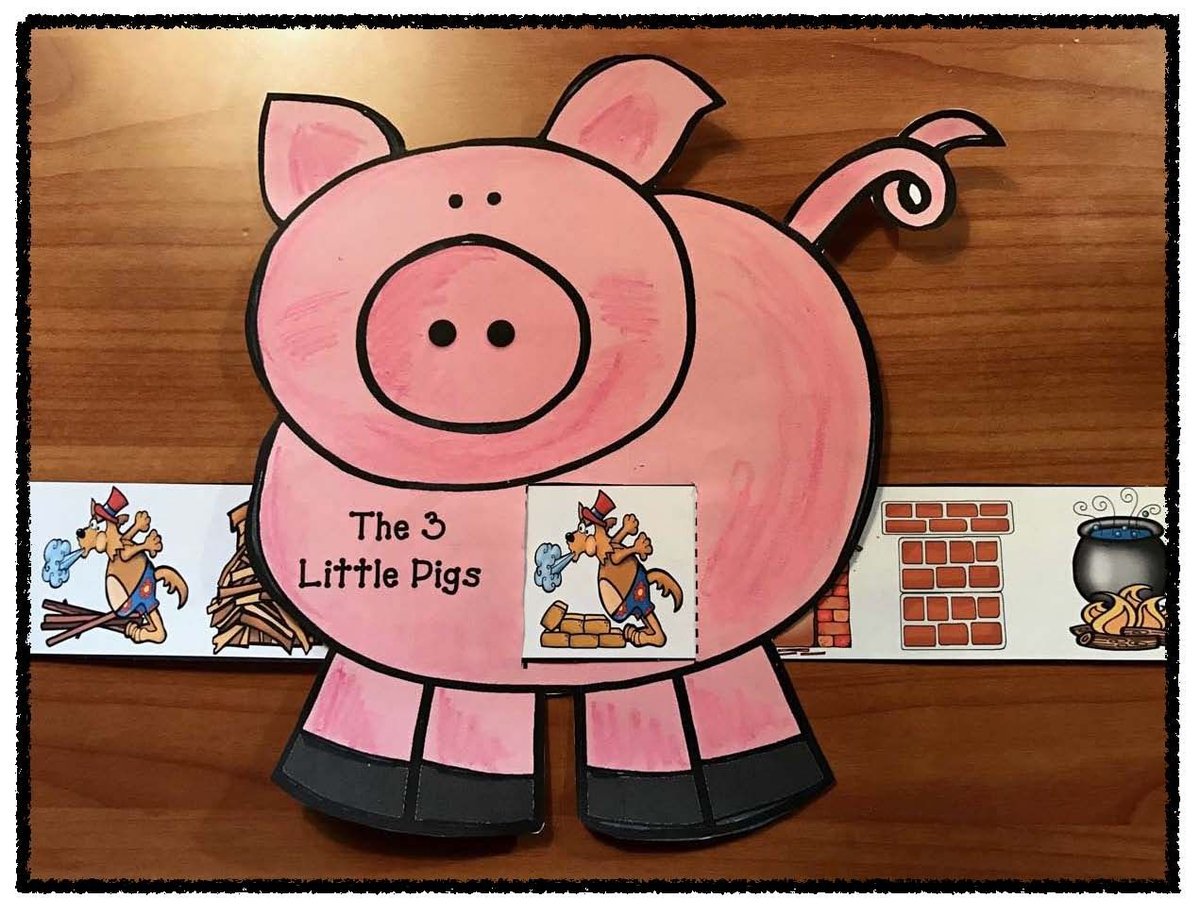
- Sequencing Crown: Create a simple paper crown with pictures representing the key events of the story (e.g., pig building straw house, wolf blowing, pig building stick house, etc.). Children can arrange these pictures in order on their crown as they retell.
- Story Sequence Cut-and-Paste: Provide printable sheets with images from the story. Children cut out the images and paste them in the correct sequence. This activity also hones fine motor skill development crucial for writing readiness.
First Words, Firm Foundations: Tracing and Reading
Early literacy isn't just about reading; it's about developing pre-reading skills and familiarity with print.
- Tracing Easy Reader Book: Utilize printable "tracing easy reader books" related to "The Three Little Pigs." These typically feature simple sentences and sight words (e.g., "The pig built a house."). Children can trace the words, reinforcing letter formation and associating spoken words with written text. This builds early confidence in reading.
Edible Storytelling: Literacy Snacks
Who says learning can't be delicious? Combining literacy with snack time makes for memorable experiences.
- Build an Edible Pig House: Draw outlines of the three different houses (straw, sticks, bricks) on paper plates. Then, provide edible building materials: pretzel sticks for the stick house, cereal (like shredded wheat or rice krispies) for the straw house, and square crackers or small cookies for the brick house. Children can use cream cheese or peanut butter as "mortar" to build their edible houses on the outlines. As they build, encourage them to describe which house they are making and why. This is a delightful multi-sensory activity that reinforces the story's core concepts.
Counting, Sorting, and Smart Play: Math Activities with a Piggy Twist
Mathematical concepts are naturally woven into "The Three Little Pigs," from counting pigs to distinguishing shapes.
Shape Up! Identifying and Sorting
The houses in the story provide excellent opportunities to explore geometric shapes.
- Shape Sorting Printable: Create or find a "Shape Sorting Printable" with pig-themed cards. For example, a pig might need to live in a house with a square door, a triangle roof, or a circular window. Cut out various shapes (squares, circles, triangles, rectangles) from construction paper. Children then match the cut-out shapes to the corresponding pig-themed cards. This activity reinforces shape recognition and classification.
Numbers Come Alive: Color By Number Fun
Number recognition and fine motor skills go hand-in-hand with these engaging worksheets.
- Three Little Pigs Color By Number: Utilize "Color By Number Worksheets" featuring the pigs, the wolf, or their houses. Each section of the drawing will have a number corresponding to a specific color. As children color, they practice number recognition, learn to follow instructions, and strengthen the small muscles in their hands crucial for writing.
Singing, Squealing, and Smiling: Songs & Rhymes to Delight
Music and rhythm are powerful tools for memory and engagement, and pigs have inspired many catchy tunes!
- Musical Storytelling: Incorporate songs that relate to the story or pigs in general.
- Disney's "The Three Little Pigs Symphony": If you can find the lyrics (and maybe even a recording!), this classic song beautifully retells the story in a musical format. Learning the lyrics and singing along helps with memorization and auditory processing.
- "This Little Piggy Went to Market": A timeless nursery rhyme that's perfect for finger-play and introduces children to the sequence of events.
- "Pigs Galore": Find or create a simple song about pigs that highlights their characteristics – "Pigs love mud, pigs love to grunt, pigs have curly tails!" Incorporating movement with these songs makes them even more engaging.
Feasting Fun: Themed Snacks That Delight
Turn snack time into an extension of the story with these themed treats that are sure to bring smiles.
- Pigs in a Blanket: A classic for a reason! Use miniature hot dogs and 1/2-inch refrigerated biscuit dough. Wrap each hot dog in a piece of dough and bake at 350 degrees Fahrenheit for approximately 12 minutes, or until golden brown. Serve with ketchup or mustard for dipping. This simple snack is a huge hit and directly connects to the story's characters.
- Pink Pig Punch: A delightful and refreshing drink. Combine strawberry ice cream (or raspberry sorbet) with pink lemonade. Blend until smooth and frothy. For an extra touch, you can add a gummy pig or a slice of strawberry to the rim of the glass. This vibrant drink is a fun, thematic treat.
Making it Easy: Pro Tips for Low-Prep Learning
We know you're busy! Here are some journalist-approved tips to make these activities enjoyable without overwhelming your schedule. The goal is engagement, not perfection.
- Keep It Simple, Always: Don't feel pressured to do every activity. One or two activities a day, or even just focusing on one main project for a week, is more than enough. The quality of engagement far outweighs the quantity of activities. Many preschool craft ideas can be adapted for very little prep.
- Gather Supplies First: Before starting, take a quick inventory and gather all the necessary materials. A few minutes of prep can save a lot of frustration during the activity.
- Embrace Their Own Words: Encourage children to retell the story in their unique way, even if it doesn't perfectly match the original. Their creativity and developing narrative skills are what matter most. Don't correct; celebrate their storytelling!
- Use Printables Strategically: When focus might be an issue, printables (like sequencing sheets or coloring pages) can be excellent tools. They provide a structured activity that helps maintain attention and offers a sense of accomplishment.
- Puppets Are Your Best Friend: Simple stick puppets or finger puppets are incredibly versatile. They can be used for retelling, character voice practice, and even conflict resolution ("What would the pigs do now?").
Beyond the Bricks: Cultivating Curiosity and Creativity
The tale of the Three Little Pigs is more than just a lesson in building strong houses; it’s an invitation to explore a world of concepts, emotions, and creative expression. By engaging in these diverse activities and crafts, you’re not just passing the time; you’re laying crucial foundations for your child's cognitive, emotional, and social development.
From the first reading to the final, delicious snack, each activity offers a chance to deepen understanding, build essential skills, and create cherished memories. So go ahead, grab your straw, sticks, and imaginary bricks. It's time to help your little ones huff, puff, and build their way to a love of learning that will last long after the wolf is gone.